
A guide for families
AI after-school programs: what they are and why they matter
More and more families are searching for an AI after-school program. Almost none of them find a serious explanation of what should happen inside one. This page is that explanation: why it matters, what skills are really at stake, and how to tell a real program from a trend workshop. We write from experience: we built the first one in Alicante, and we're still inventing the category as we teach it.
Why it matters now
AI is not kids' future. It's their present. It's already in the search engine they do homework with, the videos they watch, the apps they play with. They will spend their entire lives working with machines that write, draw, code, and answer any question — and almost nobody is teaching them to use those machines well.
Directed well, AI is the most powerful tool they will ever hold. A nine-year-old can build an app today that five years ago took a team of engineers. The difference between consuming that technology and creating with it gets decided now, at this age, while the habits form.
Parents are reaching the same conclusion, and that's why they search for an AI after-school program: a weekly class where someone who works with these tools teaches kids to use them well. It's the natural answer. The surprise comes next: that program barely exists. Robotics academies have added "AI" to the label and coding academies have added a module, but a program built around AI itself — in person, through the whole school year — is almost nowhere to be found. In Spain, ours is the only one we know of.
We know because we were those parents. We wanted this class for our own kids, couldn't find it, and built it — first as a camp for them in a village in León, then as the first AI after-school program in Alicante, taught at Torre Juana, the city's AI hub. There was no one to copy, so we invent it as we teach: we come from the startup world, not traditional education, and the program changes as fast as the tools do.
The launch was covered by El Español's artificial intelligence section.
Read the El Español coverageWhat is an AI after-school program?
The honest answer first: like AI itself, this category is still being figured out. There's no official curriculum, no standard to inherit, no program that has run for twenty years and settled the debates. Every program you'll find — ours included — is an attempt at the answer, not the answer.
The core is clear enough: an AI after-school program teaches kids AI. What it is, how it works, where it fails, and how to use it to make things — until working with it feels normal, not novel. Any program that deserves the name does at least that.
Everything beyond that core is a set of choices: what to teach, what to avoid, what to aim for. Those choices are what separate a serious program from a trend workshop. We've been making them class by class since our first camp — and this is what we've learned.
What we think it should be
Kids directing AI to build real things: apps, games, comics, stories. They decide what to build, communicate it to the machine, examine what comes back, and judge whether it works. The AI supplies the technique. The kids supply the intent and the judgment.
That's how the professionals building technology work today — like an architect directing a team. And it's why the learning doesn't expire with the tool: a kid who learns to direct one AI can direct the next one.
And what it shouldn't be
- It's not robotics with parts: kids don't assemble a kit from instructions, they create their own project from scratch.
- It's not "the ChatGPT class": the tool doesn't matter; knowing how to plan, communicate, and verify does.
- It's not leaving a kid alone with a chatbot: every session is led by an instructor who sees every project.
- It's not screen consumption: it's creation.
The real skill is not technical
Those lines aren't a matter of taste — they follow from what the skill actually is. What makes AI work is not typing instructions. It's everything that happens before and after: defining a problem, breaking it into pieces, judging whether what the machine returns is true, good, or useful. That has a name: critical thinking and problem solving. Those are the skills an AI program must teach; the tool is just the training ground.
And here is the risk of not learning them. Underneath, AI is a prediction machine: it doesn't always tell the truth and it doesn't know what your kid wants. A kid who doesn't learn to think with it ends up delegating to it the one thing that can't be delegated — the thinking. A kid who does turns it into the best team they'll ever have. What to ask, what to trust, what to build: that judgment is the subject.
How we do it at AI Kids Club: learn by building
Judgment isn't learned from a lecture. It's learned by making decisions and seeing what happens. That's why the whole program is learning by doing: no worksheets, no exercises. Every student has a real project in their hands, every week, from the first session to Demo Day. And the project is their own idea: that ownership is what makes the learning stick.
A session doesn't start on a screen. It starts on paper.
01
Plan
Each one decides what to build and draws or writes it on paper: what it does, who it's for, how it looks.
02
Build with AI
They turn the plan into instructions, examine what the AI returns, correct, and ask again. That is where the real learning happens.
03
Test and present
Classmates try it, feedback comes in, the project gets better. At the end of the program they present it to families at Demo Day.
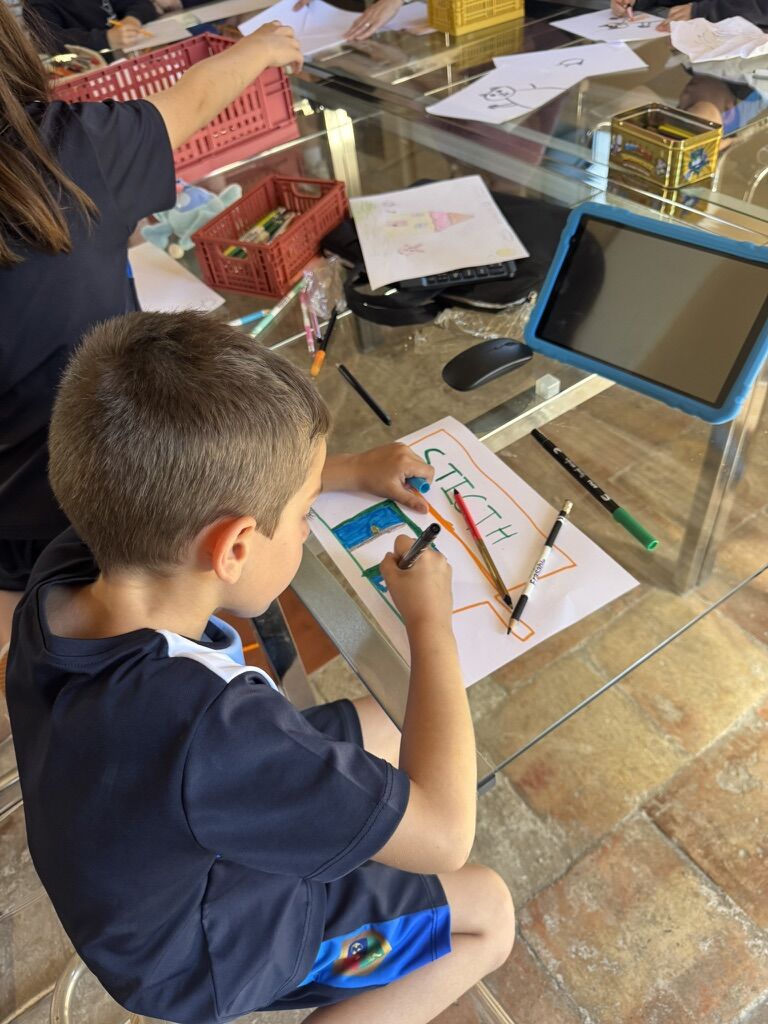
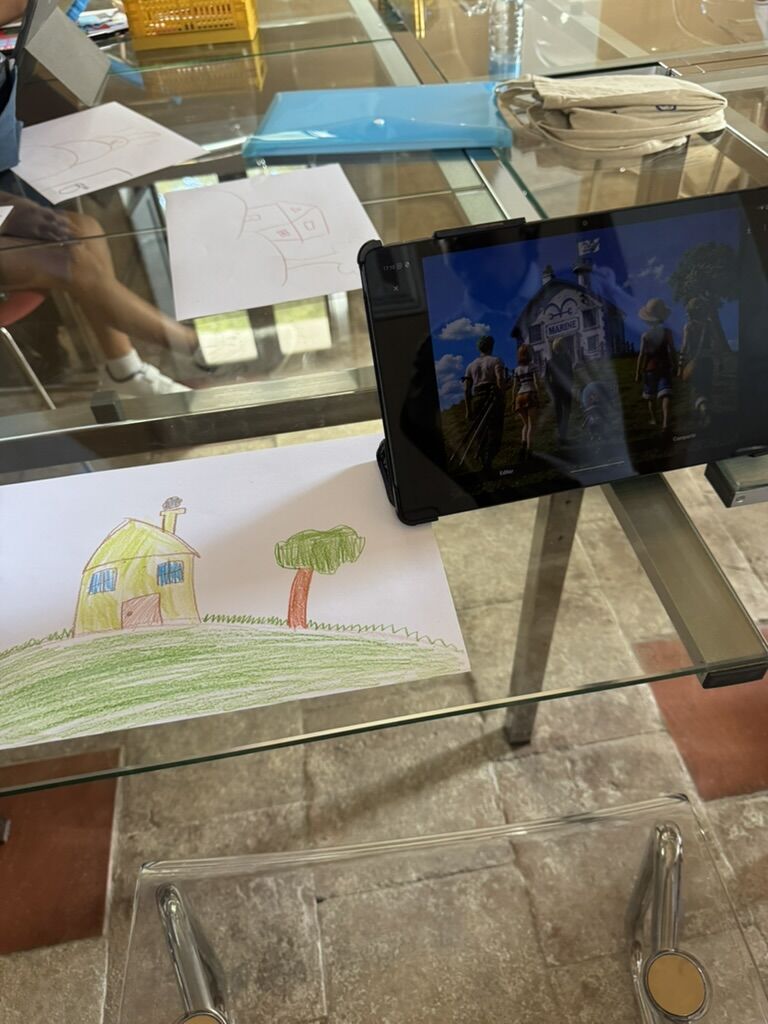
Everything on our projects page was imagined, planned, and built by kids aged 7 to 12. See real student projects
Spark: the platform that makes it possible
Students create in Spark, our own AI platform for kids. We built it from the ground up for exactly this: it removes the technical friction so a kid's idea can become an app, a game, a story, or an image — even starting from their own paper drawings.
And the adult never disappears: the instructor controls when it is available and sees every project. No kid works alone with an open chatbot.
See Spark for yourself spark.aikidsclub.orgMore than a technology class
A good AI program is not a screen class. Projects start on paper. Kids explain their ideas out loud, try what their classmates are building, give feedback and take it. And at the end of the program each one presents their project to families at Demo Day — standing, in front of a room — the way a founder pitches a startup.
What they take away goes beyond the technical. It's an identity: builder, not user. A kid who has turned their own idea into a working app never looks at technology the same way again.
And the skills — planning, communicating, judging, presenting — apply to everything they will ever do with an AI: next week's homework, the first job, and the jobs that don't exist yet.
How to choose an AI program for your kid
The "AI" label sticks to anything these days. These are the questions we would ask before signing up a child — of any program, including ours.
What does your kid walk away with?
A certificate is not an outcome. An app, a game, or a story they can show their family is. Ask to see real projects from previous students.
Real tools, supervised?
A serious program works with real AI under instructor control — not toys that simulate AI, and not open chatbots with no supervision.
Does it teach kids to distrust AI?
If the program doesn't explicitly teach when AI gets things wrong and how to verify it, it's teaching kids to obey the machine, not direct it.
Small groups?
Directing AI takes constant conversation with the instructor. With more than ten kids per group, that disappears.
Who teaches?
Ask whether the instructor has built real products with these tools — or is one lesson ahead of the students.
Does your kid present their work?
Presenting the project to other people teaches communication, not just building. It's half the value.
What about robotics? Or coding?
Robotics teaches kids to assemble and program a kit; classic coding, to write code line by line. An AI program teaches the layer that now sits above both: directing machines that already know how to code. They're different things, and we compare them in detail.
Robotics vs. AI for kidsFrequently asked questions
From what age does it make sense?
From 2nd grade (around age 7) up to secondary school, in groups split by grade. Younger kids start with visual creation and stories; older kids build more complex apps and games.
Does my kid need to know how to code?
No. No experience needed: the first tool is paper and pencil, and the AI handles the code. What they learn is to plan, communicate, and decide.
Is it safe? Do kids use ChatGPT on their own?
In our case, no: kids create in Spark, our own supervised AI platform for kids. The instructor controls when it is available and sees every project. No kid works alone with an open chatbot.
How much does an AI after-school program cost?
Technology extracurriculars in Spain run from €30–60/month (kit-based robotics) to over €100/month. Ours costs €100/month: a weekly 90-minute class, groups of 10 or fewer, tools included.
Won't what they learn become obsolete?
Tools change; the skill doesn't. Whether it's Claude, ChatGPT, or whatever comes next, knowing how to plan a project, communicate it to an AI, and verify the result works with all of them.
Where can I find an AI after-school program?
In Alicante: ours runs weekly at Torre Juana from September to June, in English or Spanish. See how the program works.
Looking for an AI program in Alicante?
Weekly classes at Torre Juana from September to June, from 2nd grade to secondary school. Groups of 10 or fewer, in English or Spanish.
See the Alicante program